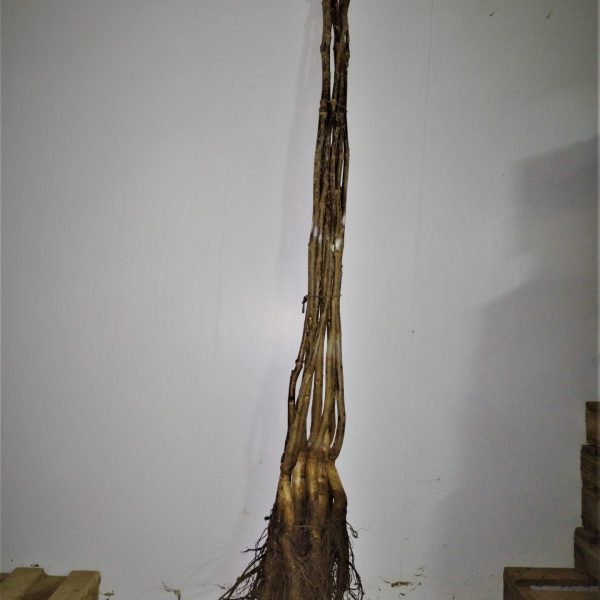
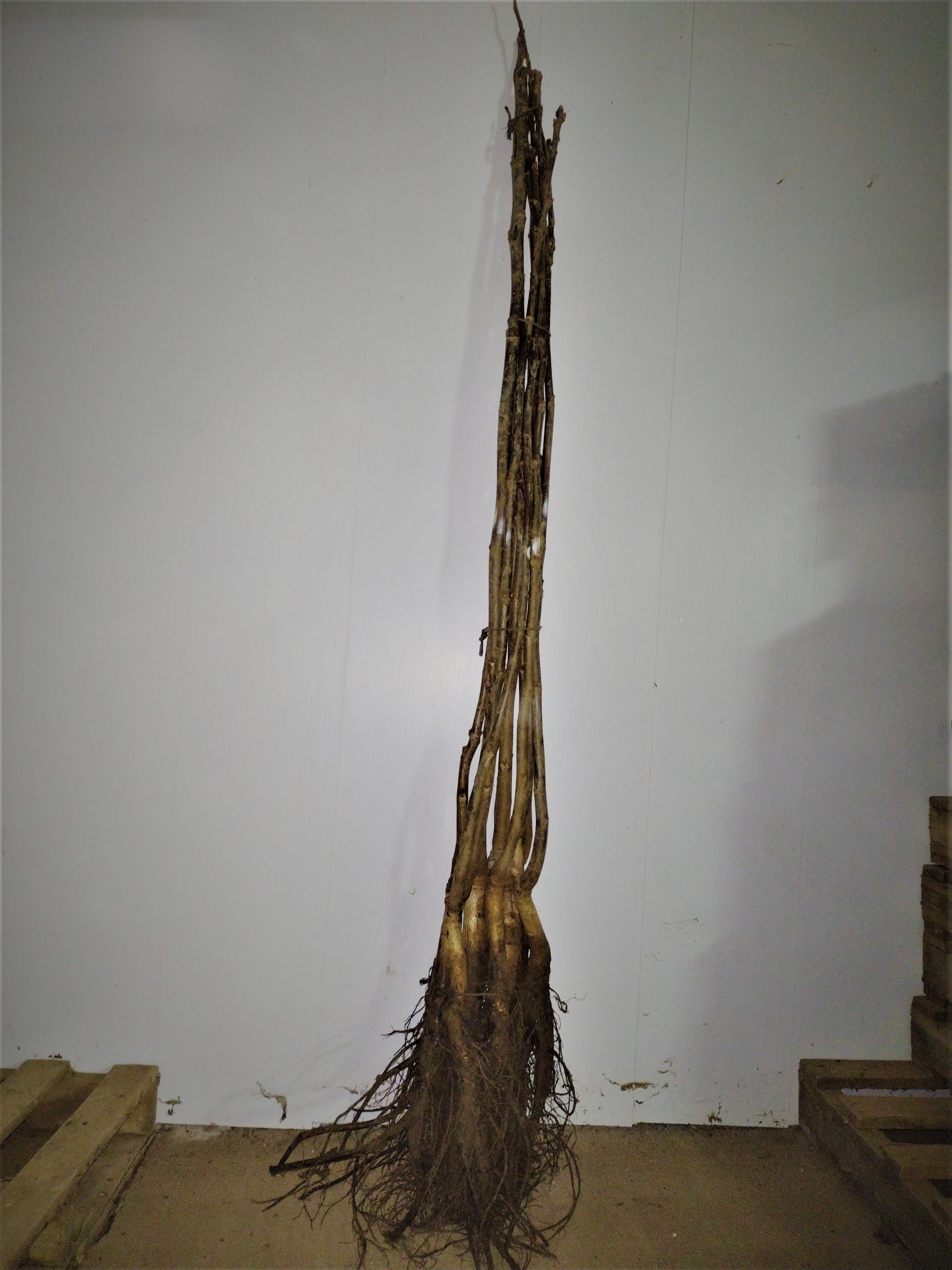

Beschreibung
The red walnut, Red Livermore, was selected in 1991 at the University of California, Davis. These red walnuts, often called „blood walnuts,“ were bred through a controlled cross between the variety „Howard“ (female parent) and the variety „Purpurea“ (male parent), a Persian red-skinned variety. The Howard parent walnuts have a characteristic amber-colored kernel skin. The kernels of the „Purpurea“ variety have a reddish-brown kernel skin.
The new Californian variety with red kernels was named „Robert Livermore.“ Robert S. Livermore was a longtime supporter of the Walnut Improvement Program at the University of California, and this walnut is honored by its naming. This red-kernelled walnut tree is also commonly known as „Red Livermore.“
The unique characteristic of the Livermore walnut lies within its shell. The nuances of the reddish-hued kernel skin make it particularly attractive. Furthermore, this red-skinned walnut is among the best-tasting varieties.
Height growth and tree crown
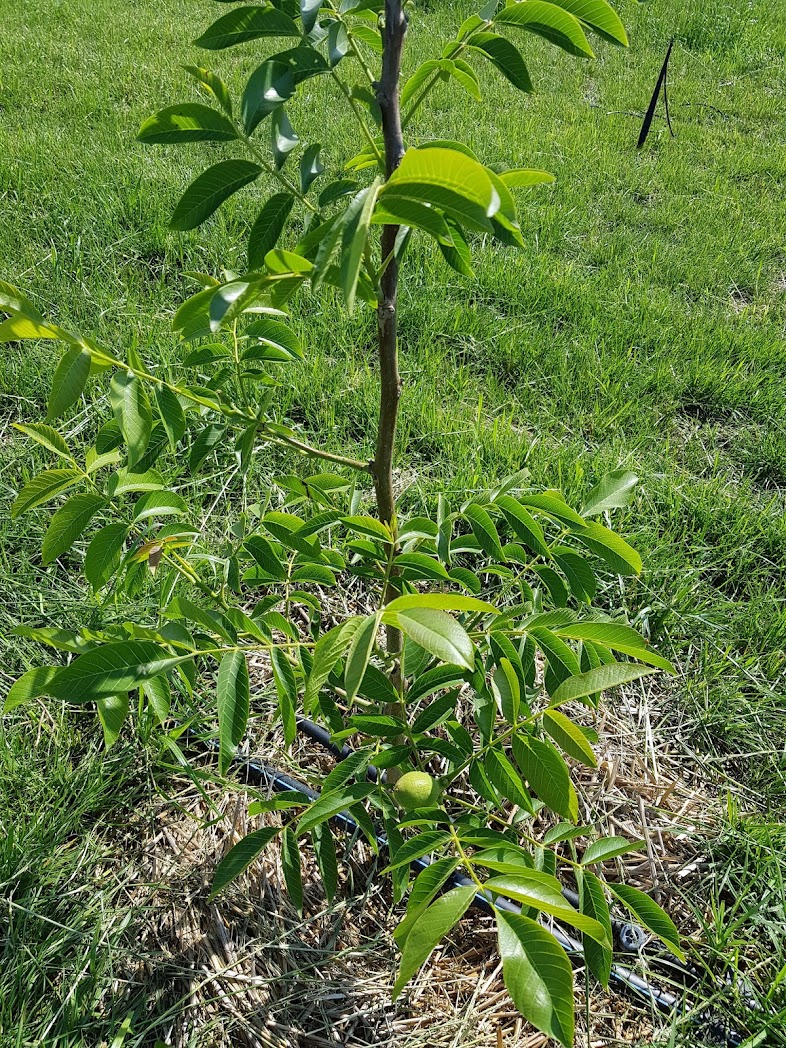
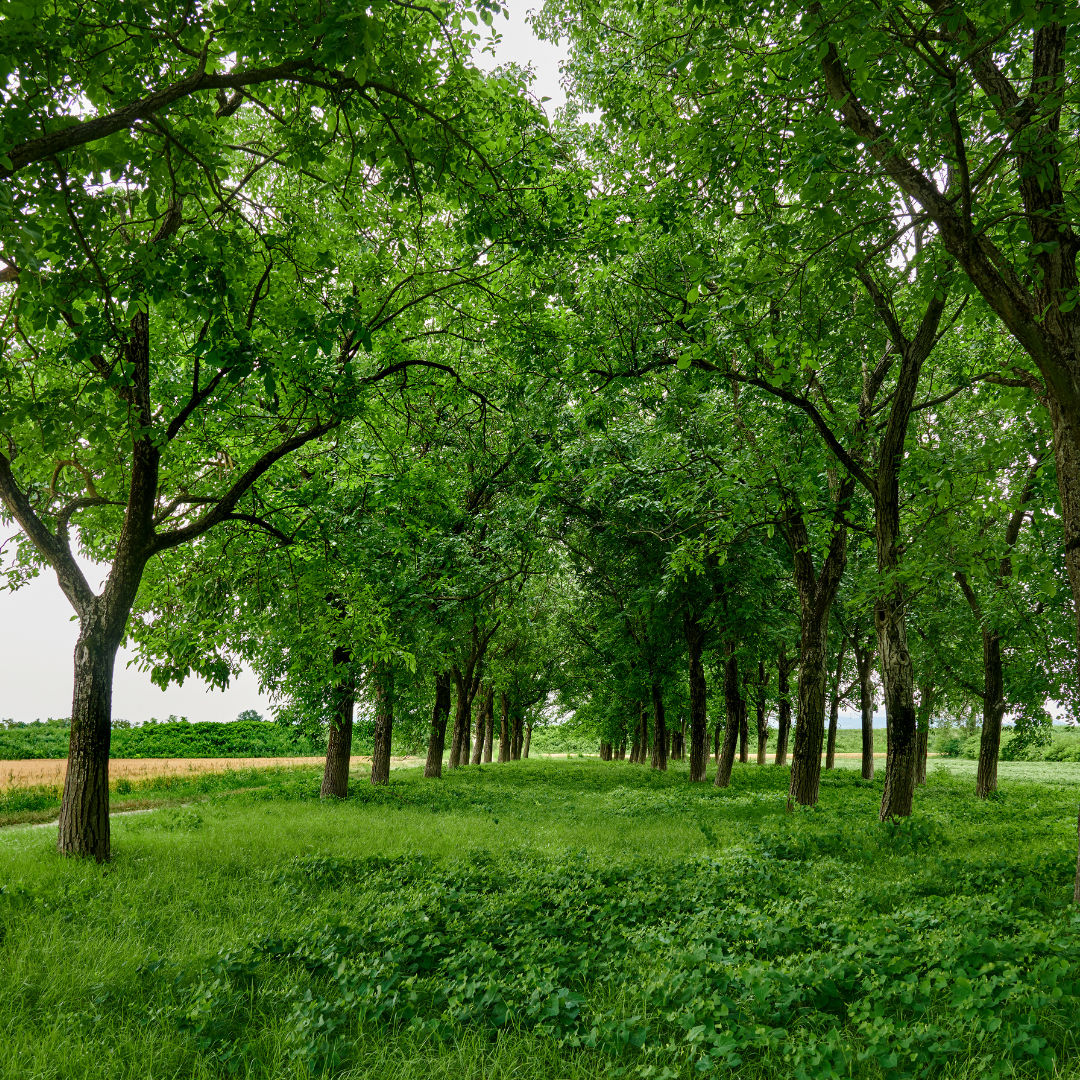
The Red Livermore walnut grows more vigorously (less than Franquette). A three-year-old tree typically reaches a height of 5-6 m and a crown diameter of about 3 m. The mature height of the walnut tree can reach 10 to 18 m.
The bark of young, woody twigs is smooth, brownish to dark brown with numerous raised white lenticels. The bark of the mature Red Livermore walnut is smooth and distinguished by a few greyish-white lenticels and some cream-colored vertical markings.
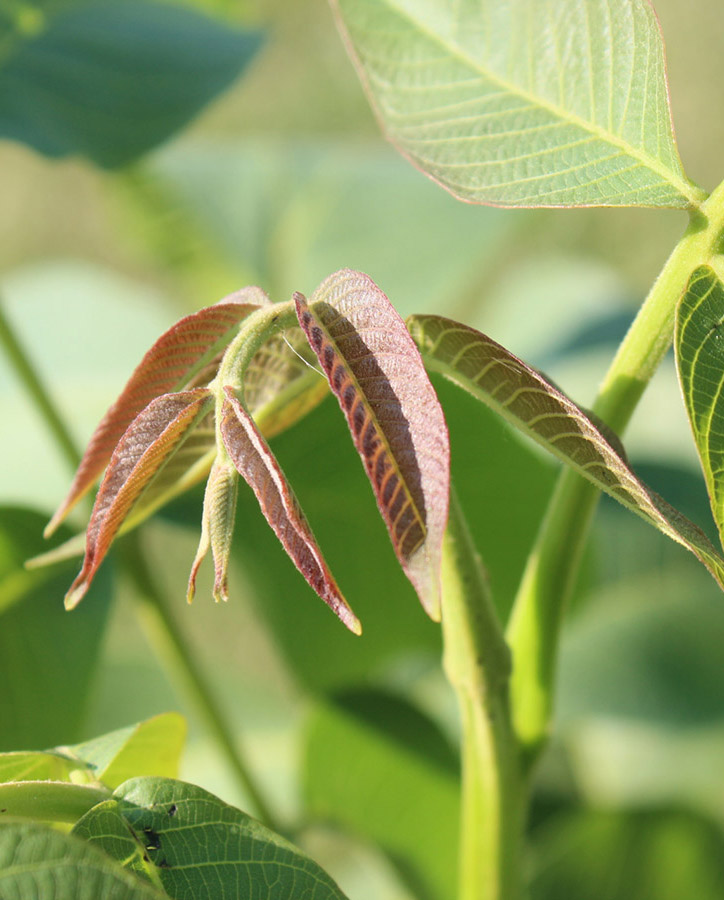
The attractive dark green foliage is typical of Juglans regia. The leaves are pinnate with 5-9 leaflets, approximately 40 cm long and 25 cm wide. The leaf margins are entire. The petiole diameter is about 3.5 mm. The foliage releases a wonderful fragrance when crushed.
Red Livermore walnut trees naturally form a beautiful and regularly shaped crown.
Flowering time / leaf emergence
 The walnut variety ‚Red Livermore‘ buds and flowers late. The first blossoms can appear on trees as young as two years old. Flowering typically occurs around the same time as the ‚Chandler‘ variety. Flowering takes place in three stages: it begins around April 21st, peaks on April 26th, and ends on average on May 1st (depending on the geographical region). ‚
Red Livermore‘ is protandrous, meaning the male flowers bloom earlier than the female ones.
pollination
The Red Livermore walnut is self-pollinating. For higher yields, other walnut varieties, such as Chandler or Franquette, are used as pollinators.
yield
 The relatively new Red Livermore variety has proven to be quite early maturing. The walnut tree begins bearing nuts as early as its second year of growth. Among the great advantages of the Red Livermore walnut are its abundant and consistent yields.
The red-kernelled variety is a lateral-bearing variety. Approximately 90 percent of the lateral buds are fruitful. This variety is regularly stored (not alternately) and its nuts ripen late.
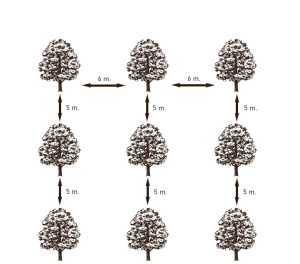
Typical spacing for planting Red Livermore walnut trees is 5 x 6 m, resulting in 330 trees per hectare.
Nut and fruit hull quality
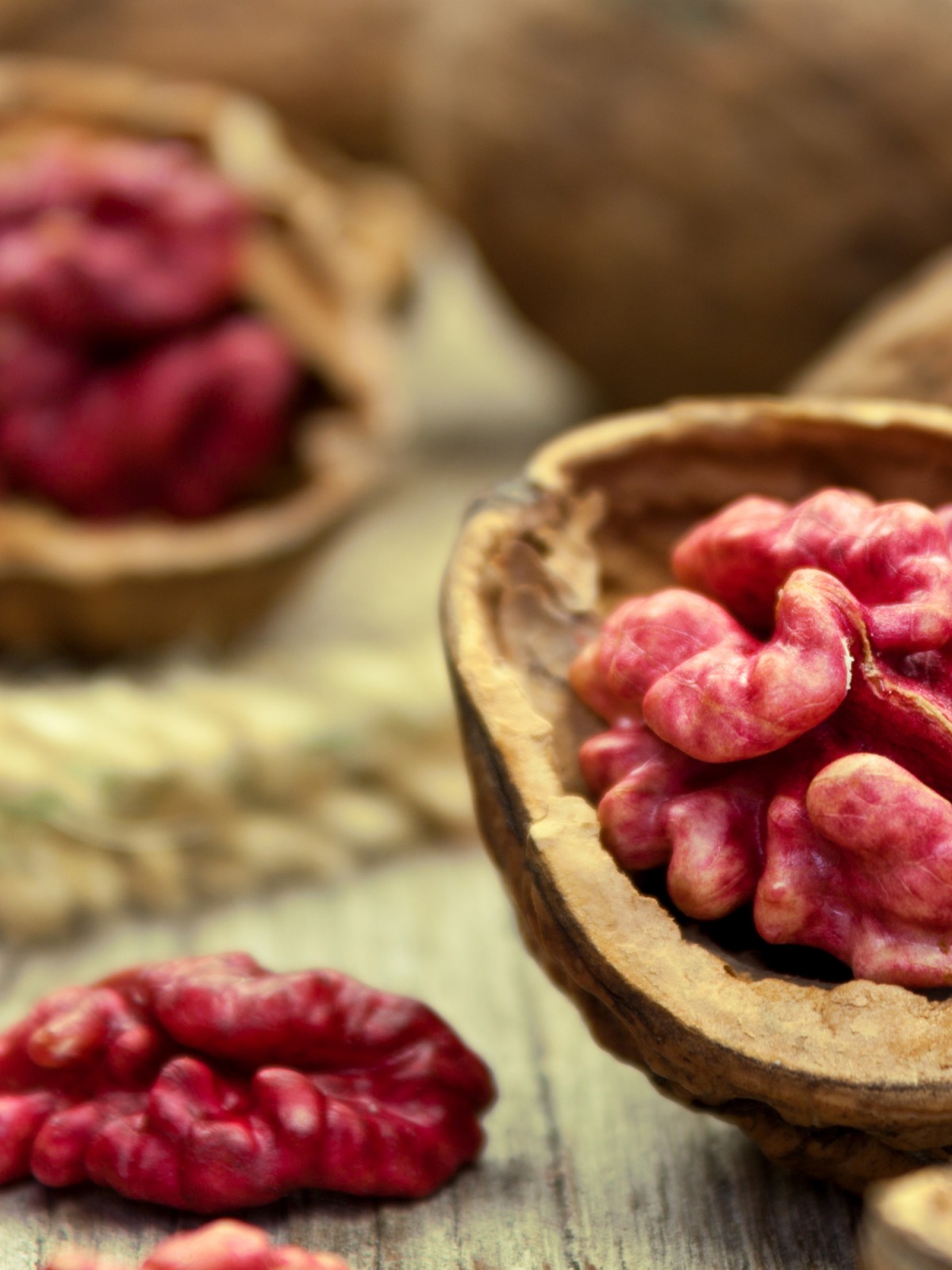
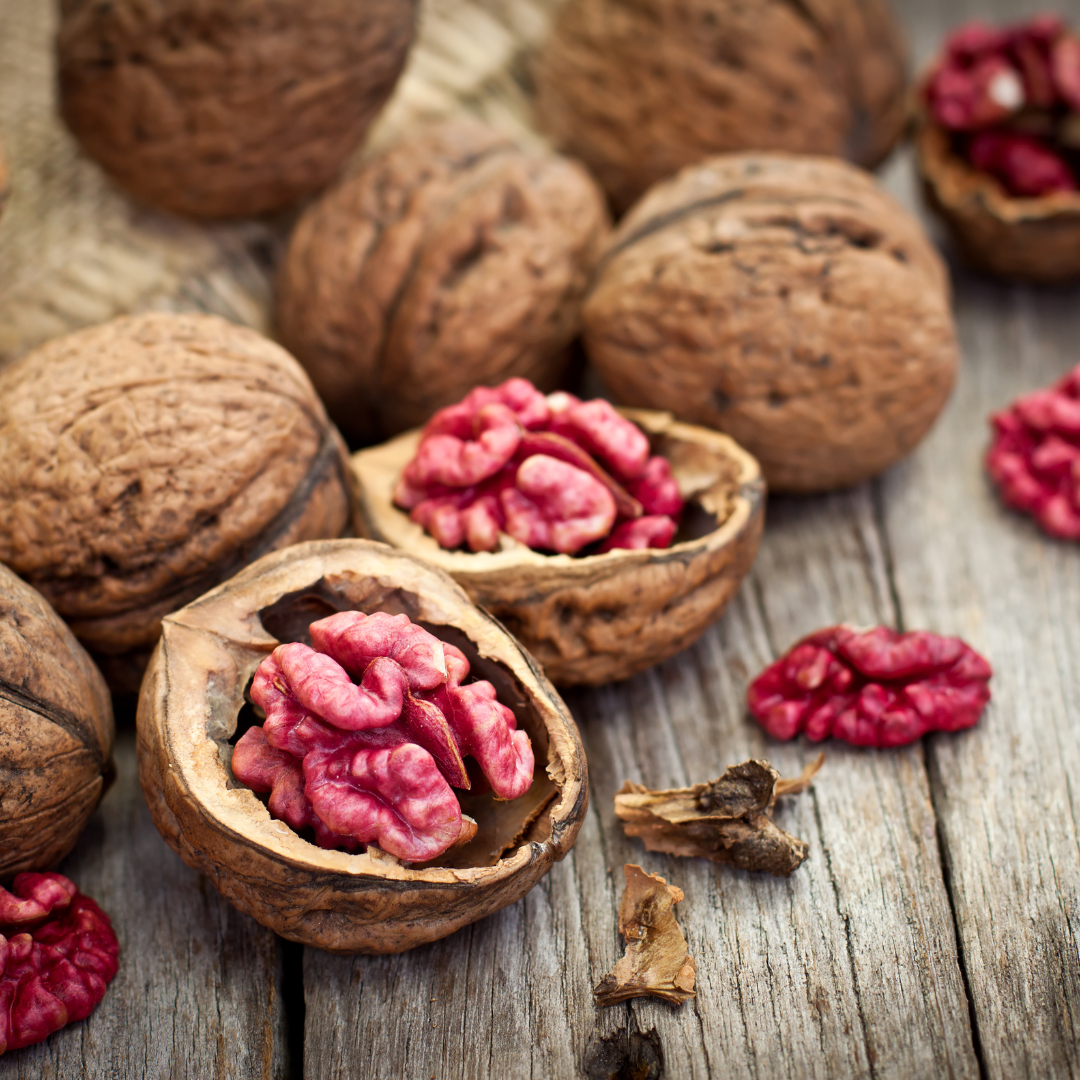
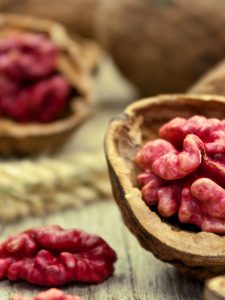 The medium to large fruit of the Livermore walnut delights with its excellent flavor and is distinguished by its striking red kernel skin. Thanks to its unusual red color, the fruit is very decorative.
The Red Livermore walnut produces bright red kernels with a distinctive reddish-purple skin. Its glossy, red kernel is not only decorative on any nut tart, but also exceptionally flavorful with a pronounced, sweet, and typical walnut aroma. The nearly round nuts have an average weight of 14.8 g and a uniform size of approximately 3.5 centimeters in diameter (averaging 37.8 x 35.0 x 31.9 mm).
The nutshell is robust, deeply furrowed, yellowish-brown in color, and easily cracked by hand. The high-quality kernel is light reddish-purple, completely fills the shell (kernel content 47-50%), separates very easily from the shell, and displays a characteristic, atypical reddish-purple membrane. The average kernel weight is 7.1 g.
The flavor combines the slight bitterness of the skin with the soft and delicate taste of the kernel. These exceptionally flavorful nuts are mild, with a fine, creamy aroma, and are exceptionally digestible. Their festive, reddish-purple skins make them particularly suitable for enjoying at holidays, parties, or other special occasions. Due to its unique, naturally occurring color, the Red Livermore walnut commands a higher market price than traditional varieties.
Harvest time
The optimal time for harvesting Livermore walnuts is early October.
Disease resistance and frost sensitivity
The Red Livermore walnut exhibits good tolerance to leaf spot diseases such as bacterial blight and anthracnose. This red-kernelled walnut is generally very winter-hardy and, due to its late budding, resistant to late frosts.
|
Height growth |
Vigorous, straight growth. The bark is brownish when young, becoming increasingly gray with age. |
|
treetop |
The crown is wide and expansive. |
|
Flowering time / |
It sprouts and blooms late – almost simultaneously with Chandler; the first flowering occurs in the 3rd year. Flowering takes place in 3 stages – it begins around April 21st, peaks on April 26th and ends – on average – on May 1st. |
|
Dichogamy |
Protandrous (the male flowers appear before the female ones) |
|
Self-pollinating |
Partially self-pollinating |
|
pollinator varieties |
Chandler, Franquette |
|
Fruit set |
Laterally bearing – Approximately 90% of the lateral buds bear fruit. |
|
fruit |
Early fruiting; regular yields; the size of the walnuts can vary depending on the yield during a given growing season. |
|
Fruit wall (the peel or |
Almost round shape, large, weight – average 14.8 g. Yellowish-brown color, strong, thick, almost round (36×35 mm) |
|
Fruit kernels |
The kernel is easy to separate and fills the shell well. Large, with a very good flavor (creamy taste – combining a slight bitterness of the skin with a soft and delicate taste of the kernel), characterized by a distinctive reddish-purple skin; the average weight of the nuts is 7.1 g; the kernel measures approximately 28 mm long and 29 mm wide; |
|
Harvest time |
Early October |
|
Fat content in nuts |
High fat content |
|
core component |
48% |
|
Winter hardiness |
Good frost resistance |
|
Late frost |
Minimal risk of late frost |
|
drought resistance |
Resistant |
|
Disease resistance |
Virtually resistant to bacterial canker and anthracnose |
„Walnuts Bulgaria“ has many years of experience in grafting and planting walnut trees. To help you calculate how many trees you need for your land, you can use this online calculator. We generally recommend allocating 3-10% of the total number of trees to the pollinator varieties Franquette and Fernette.
[wpcode id=“1755″]